Mexican Pottery
 Many
people use the term "Talvernva Pottery" to mean Mexican Pottery.
While all Talverna Pottery is Mexican, not all Mexican Pottery
is Talverna. Many
people use the term "Talvernva Pottery" to mean Mexican Pottery.
While all Talverna Pottery is Mexican, not all Mexican Pottery
is Talverna.
Talverna
Pottery is made exclusively in Puebla region using special
approved clay sites. It is recognized and regulated by the
Government of Mexico.
Real Talverna pottery has a distinctive bluish hues and often
has fluted edges.
The pottery you see in Delores Hidalgo and other market places
such as Tonala, while colorful, fun and distinctively Mexican,
is pottery.
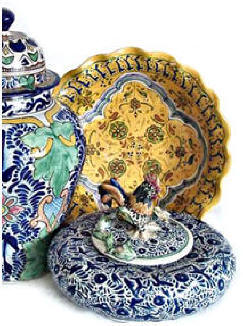 Authentic
Talavera pottery is the ceramic ware produced by
certified workshops in the state of
Puebla Mexico following the traditional process
introduced by the Spaniards in the 16th Century. Authentic
Talavera pottery is the ceramic ware produced by
certified workshops in the state of
Puebla Mexico following the traditional process
introduced by the Spaniards in the 16th Century.
In 1997 the State of Puebla obtained the
Denomination of Origin stating that only the pottery
produced in the geographical region of the State of Puebla or
Zona de Talavera (Talavera Zone) and
that follows the standards set by the Consejo Regulador de la
Talavera (Regulating Council of Talavera) can be called
Talavera.
In order to be certified these workshops
have to pass an inspection and verification process every six
months. So, just as Champagne is only produced in Champagne,
France, Talavera can only be produced in Puebla,
Mexico.
Following are some of the most important
guidelines that the Official Mexican Norm for Talavera
established:
-
Talavera : A type of original ceramic exclusive to
the denominated "Talavera Zone" (Atlixco,
Cholula, Puebla
and
Tecali,
all in the geographical region of the State of Puebla),
whose characteristics are derived from the geographical
region and that have their origins in the Spanish majolica.
-
The black and white clays used to create Talavera
pottery must be obtained from natural deposits in the
Talavera Zone.
-
The
pottery must be hand-formed, hand thrown using clay from the
designated region. The clay must be of a consistency that
does not allow pouring into molds. Molds can be used
only by pressing the clay into them.
-
Talavera must contain a tin and lead glaze base
following the formula used in Colonial times.
-
This
glaze must craze and should be slightly porous.
-
The
glaze base must not be pure white. Its coloring should have
undertones that go from Pantone 482C, 467C to 1C light gray.
-
The
pottery must be hand painted using only the six
traditional mineral pigments: blue, green, yellow, red,
brown and black. By combining these colors different tones
of blue are achieved as well as an orange and purple color.
The pigments must be made at the workshop following
long-established formulas.
-
The
painting must fuse into the glazing having a subtle, sort of
blurred appearance. The blue and/or yellow details can have
a bas-relief look.
-
Authentic Talavera has a handmade appearance,
meaning it doesn't look "machine made perfect".
Irregularities are characteristic and desirable (such as the
crazing of the glaze).
|

Back
to Articles

*
|


