 Community Profile
Community Profile
Celestún- Live Lawn Ornaments Abound
Celestún - means "Painted Stone"
Elevation – Sea Level
Climate – Hot, humid
Daily average: 23 - 30 º Celsius
Monthly variation: Hot in May/June
Rainy season: June to September
Hurricane season: July to October
High Tourist Season – Christmas, Easter
Population – 52,000
Industry – Fishing, Tourism
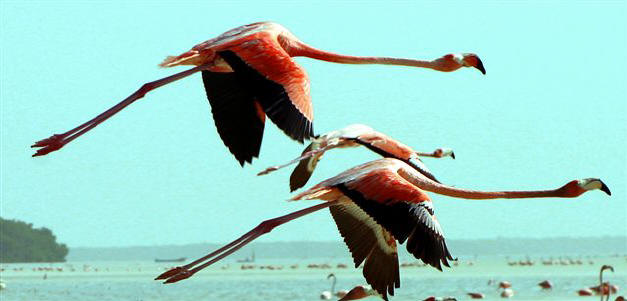
Three flamingoes fly beside out tour boat
 Driving to
Celestún
Driving to
Celestún
From Cancun take the 180 toll road to Merida. This is an easy 4 1/2 hour drive along a very good freeway. Take the ring road around Merida and take the well marked road - Highway 261 - to Celestún. Celestún is only 50 or so topes or 56 KMS from Merida's ring road - approximately 1 1/2 hours.
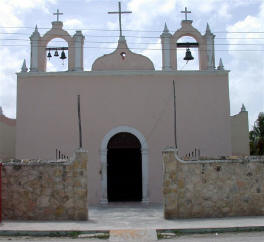
Celestún's church on the town square
Taking a Bus to Celestún
If you are in Merida and wish to take a day trip by bus, there is frequent bus service to Celestún daily. Get up early and take a taxi to Calle 71 bus terminal between Calle 62 and 64. The return fare is under $6.
A better strategy is to stay at a Celestún hotel for under $30 a night or camp at Hotel Gutiérrez
 About
Celestún
About
Celestún
Celestún is a small fishing village that is building and bracing itself for the impact of the throngs of tourists that are exploring the Yucatan Peninsula. The simple village where everyone knew one another is changing rapidly as yet another tour bus rolls into town. New people arrive. Some stay. An internet cafe opens. A new hotel. The restaurant "La Playa" expands and can now accommodate over 100 patrons. The hostel brings in the backpackers.
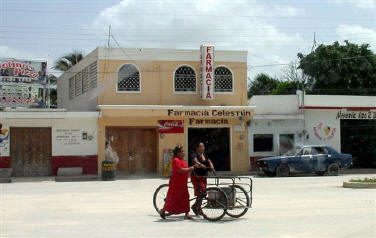
Much of the transportation is with a tri-cycle bike and
people carrier - often with a roof and used as a taxi
Word is out, yet life still goes on much the same as it has always gone on. Tricycle taxi's tether people about the dirt back roads of the town from tiny vegetable shop, or meat store and then back home again. A tiny rough town square is bordered by the village church and a few restaurants. Old men and young mothers watch children play under the shade of the trees.
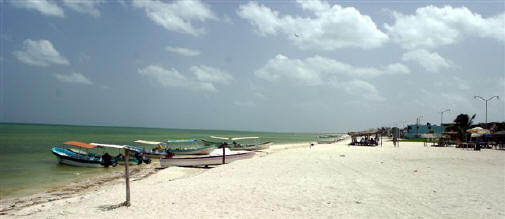
Walk kilometer after kilometer - probably alone - along white sand beach. Explore the clean waters. Wade way out into the creamy turquoise Gulf -salty warm warms waters that lap gently onto the beach. 12 meter high lighthouse stands in the distance.
White sand beach with a view of tour boats and restaurants onshore
Seafood in Celestún is king. A very inexpensive king. Go to any of the five or so beach restaurants along the water - there is only a handful. We enjoyed The Boya where two incredibly funny waiters kept us entertained. Order crab cakes or fillets with garlic. Clams, crabs, lobster, conch, octopus, fish and shrimp. Under 50 pesos or $5 for a large plate. Cerveza - Coronas, Leons or Montejos for only $1.50. Walk away amazed or buy "Take-out" a kilo of fresh picked crab with the shell off for 80 pesos or $8 at the restaurant and savor it on fresh bread rolls from the market with someone you love.
 Whatever you do take a tour to the
see the flamingoes and other amazing birds in the Rίa
Celestún Biosphere reserve. Not one or two but literally
thousands of the amazing pink gracefuls will keep you entertained. You can
arrange boat tours from the beach or from the bridge. The beach tours are longer
and take you up the estuary to the bridge where they meet the boats from the
bridge tours. Together they motor up the estuary for a few kilometers past
shrimp and crab fishers as they make their way to the flocks of flamingos.
Whatever you do take a tour to the
see the flamingoes and other amazing birds in the Rίa
Celestún Biosphere reserve. Not one or two but literally
thousands of the amazing pink gracefuls will keep you entertained. You can
arrange boat tours from the beach or from the bridge. The beach tours are longer
and take you up the estuary to the bridge where they meet the boats from the
bridge tours. Together they motor up the estuary for a few kilometers past
shrimp and crab fishers as they make their way to the flocks of flamingos.
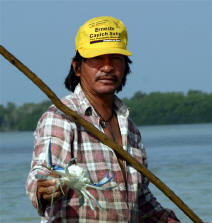
Crab fisher shows his catch as we pass by on our flamingo tour boat
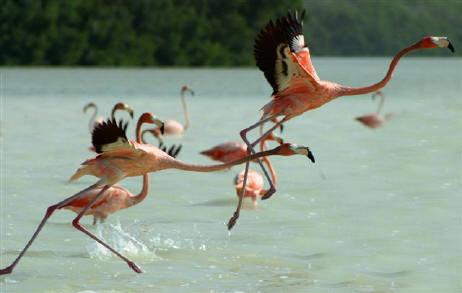
The flamingoes appear to walk on water as they begin to take flight
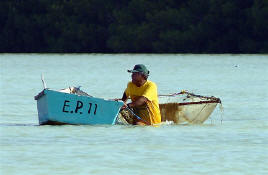
Shrimp fisherman wades out in the lagoon to place his nets
The tour guides stop and start the boat often so you get a variety of angles for picture opportunities. It is illegal to charge the birds or otherwise harass them. Later the tours visit one or both of the fresh water springs that host abundant bird and water life.
Tour prices vary with the longer beach tour
costing $100 or more for 6 people. The bridge tours are shorter and cheaper -$45
per boat for an hour and a half. Ask for an English speaking guide at the bridge
location.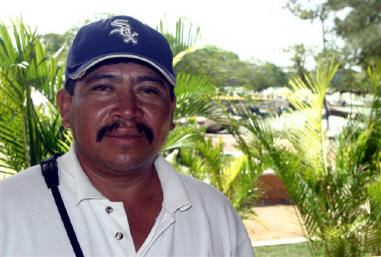
Our guide is considered not only an
expert bird watcher but speaks excellent English
Be sure to bring a book about birds, camera, binoculars, insect repellant and swim suit and towel.
 Facts
about the reserve
Facts
about the reserve
146,000 acres were federally decreed a wildlife refuge in 1979
Major feeding area for the American Flamingo and many other birds and water fowl
Upgraded to a Biosphere reserve in 1989
Hypersaline lagoon and mangrove jungle
Some freshwater springs (brackish) onshore
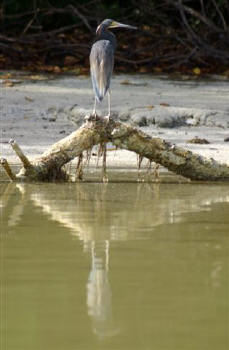
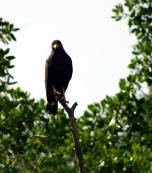
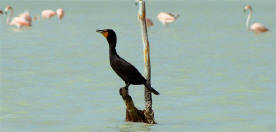
Other birds include:
Black-throated Bobwhite, Cardinals, Cormorants, Egrets,
 Flycatchers, Frigates,
Hawks, Herons,
Flycatchers, Frigates,
Hawks, Herons,
Hummingbirds including the Mexican Sheartail Hummingbird,
Kingfishers, Motmots, Orioles, Osprey, Owls, Pelicans,
Roadrunners, Sandpipers, Vultures, White Ibises,
Wood Storks, Woodpeckers, Yucatan Wren
Clockwise: Hawk, Heron and Comorant
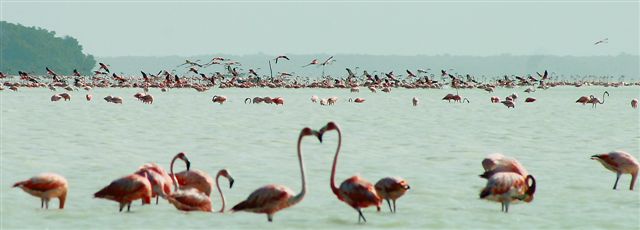
Facts about the flamingoes
Only flamingoes in the North America reside on the northern and gulf shores of the Yucatan Peninsula
Pink Flamingo (Phoenicopterus ruber)
Current population is approximately 18,000
The flamingoes huddle together in huge flocks as they eat shrimp and other small organisms from the muddy lagoon bottom
They require salty lagoon water about 1/2 a meter or less in depth to wade and feed
Thousands of flamingoes huddle together as they eat in the shallow lagoon waters
Mature flamingoes are 3 years and older. They are a brighter red and pink than their immature cousins.
If forced to fly too often they will not feed and will abandon their nests and colonies